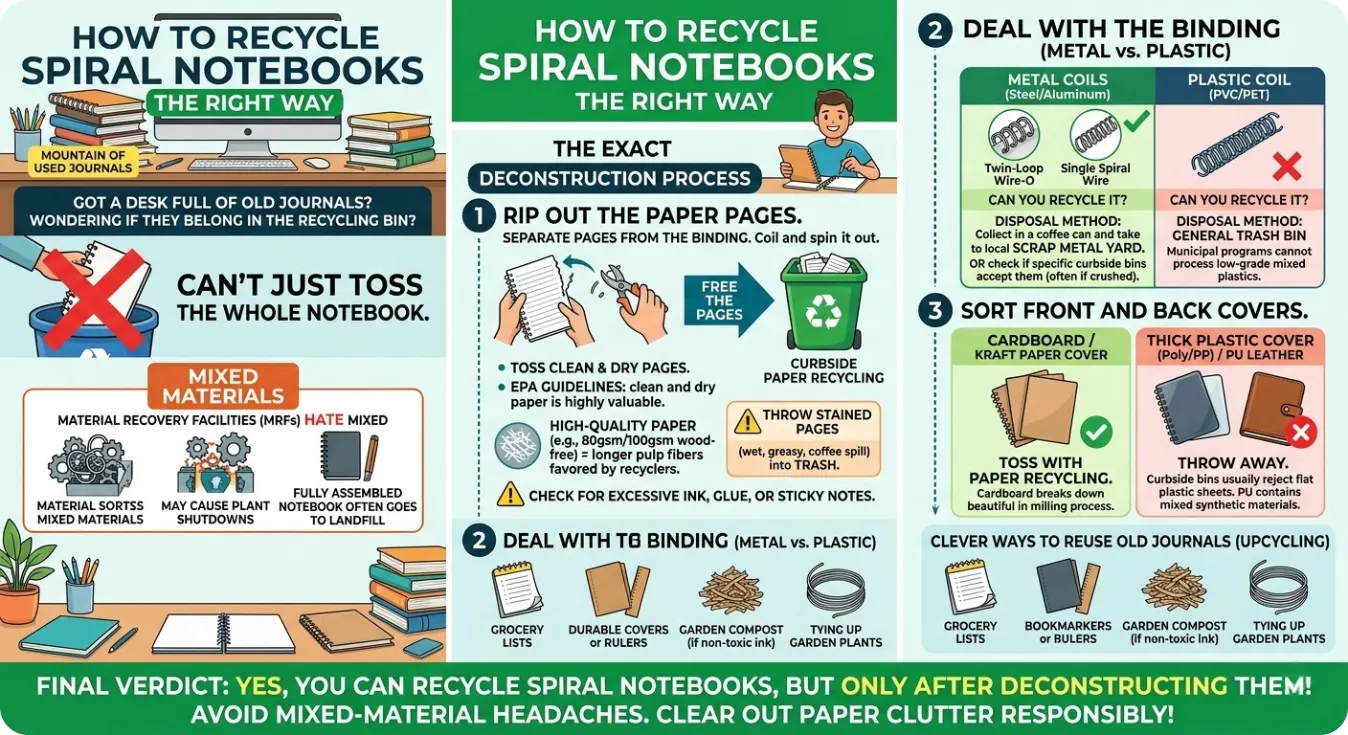
Can You Recycle Spiral Notebooks? Got a mountain of used journals sitting on your desk and wondering if they belong in the recycling bin? I will show you exactly how to recycle spiral notebooks the right way so they never see a landfill. Let’s clear out that paper clutter responsibly.
Yes, you can recycle spiral notebooks, but you cannot toss them in as one piece. You must remove the metal or plastic binding coil first. The interior paper pages go into your standard curbside recycling bin, while the coils and plastic covers require separate sorting.
However, you might be wondering what to do with the metal wire or those thick poly covers. Stick around, because I am going to break down the exact disposal steps for every single component.
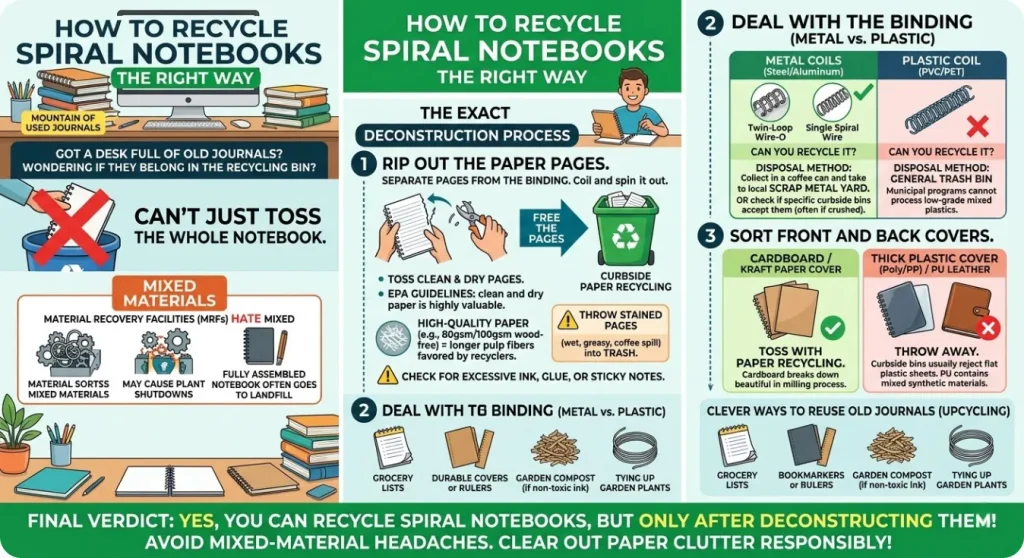
Why You Can’t Just Toss the Whole Notebook
I see people throw entire notebooks into the blue bin all the time. Naturally, you might think the recycling center will sort it out for you.
But here is the deal. Material Recovery Facilities (MRFs) absolutely hate mixed materials. Specifically, when you combine paper, metal wire, and plastic covers, you create a massive headache for the sorting machines. In fact, those metal coils often get tangled in the facility’s gears, which forces the entire plant to shut down.
Because of this, throwing a fully assembled notebook into the bin often results in the whole item going straight to the landfill. Therefore, we have to do a little bit of manual labor first.
As someone who spends a lot of time analyzing notebook manufacturing operations, I know exactly how these products come together. Manufacturers intentionally combine sturdy metal and thick paper to make the notebook durable. As a result, taking them apart requires a specific process.
How to Recycle Spiral Notebooks Step-by-Step
If you want to recycle spiral notebooks effectively, you need to break them down into their core components. Let’s dive into the exact process.
Step 1: Rip Out the Paper Pages
First of all, you need to separate the paper from the binding. You can grab the entire stack of pages and rip them away from the coil. Alternatively, you can use wire cutters to snip the ends of the coil and simply spin the wire out of the holes.
Once you free the pages, you can toss them straight into your curbside paper recycling bin. According to the EPA paper recycling guidelines, clean and dry paper is highly valuable for recyclers.
However, you should check for excessive ink, glue, or sticky notes. Furthermore, if the paper got wet or greasy from a coffee spill, you must throw those specific stained pages into the trash.
Step 2: Deal With the Binding (Metal vs. Plastic)
Next up, you have to deal with the actual spiral. This step completely depends on the material your notebook uses.
For instance, many standard A5 and B5 journals use a metal wire-o binding. Fortunately, scrap metal yards love steel and aluminum wire. You can usually collect these metal coils in a coffee can and drop them off at a local scrap facility. On the other hand, some local curbside programs will accept small metal coils if you crush them down, but you should always check your local rules first.
Conversely, if your notebook uses a continuous plastic coil, you usually have to throw it in the trash. Because plastic coils consist of low-grade mixed plastics, most municipal recycling programs simply cannot process them.
To make this easier, I created a quick breakdown of how to handle different binding types:
| Binding Type | Material | Can You Recycle It? | Disposal Method |
| Twin-Loop Wire-O | Steel or Aluminum | Yes | Scrap metal yard or specific curbside bins |
| Single Spiral Wire | Steel or Aluminum | Yes | Scrap metal yard or specific curbside bins |
| Plastic Coil | PVC or PET Plastic | No | General trash bin |
Step 3: Sort the Front and Back Covers
Finally, you need to look at the covers. Standard notebooks usually feature either a cardboard backing or a flexible plastic (poly) cover.
If your notebook has a plain cardboard or Kraft paper cover, you can confidently toss it in with the rest of your paper recycling. Simply put, cardboard breaks down beautifully in the paper milling process.
However, if your notebook features a thick plastic cover (often made of PP or Polypropylene), you usually need to throw it away. While some specialized facilities handle PP plastics, standard curbside bins usually reject flat plastic sheets. Moreover, if your journal uses a PU leather cover, that also goes straight into the garbage because it contains mixed synthetic materials.
The Manufacturing Side: Why Paper Quality Matters
Let’s look behind the scenes for a moment. Working closely with notebook manufacturing operations, I see firsthand how paper specifications impact the recycling process.
When you recycle spiral notebooks, the weight and quality of the paper actually matter a lot. For example, most premium journals use 80gsm or 100gsm wood-free paper. Consequently, this high-quality, uncoated paper yields longer pulp fibers during the recycling process.
Recycling facilities absolutely love this type of paper. They can easily break down 100gsm wood-free pages and turn them into new, high-quality products.
On the other hand, if a notebook uses heavily coated paper or glossy photo-style pages, the recycling plant has a much harder time removing those chemical layers. Therefore, choosing a journal with standard, uncoated paper makes your end-of-life disposal much more eco-friendly. According to the Recyclopedia guide on spiral bound books, keeping your paper free of heavy plastic laminations ensures a smooth recycling loop.
Clever Ways to Reuse Old Journals
Before you rip your notebook apart, you might want to consider reusing it. In fact, upcycling gives your paper products a much longer lifespan than traditional recycling.
Here are a few of my favorite ways to squeeze more life out of an old notebook:
- Create a scrap paper pad: You can rip out the unused pages, clip them together, and use them for quick grocery lists.
- Save the covers: If you have a sturdy plastic cover, you can cut it down to use as a durable bookmark or a straight-edge ruler.
- Compost the paper: If you use non-toxic ink, you can shred the leftover Kraft paper pages and toss them straight into your garden compost bin.
- Keep the metal coil: You can stretch out the metal wire and use it to tie up unruly tomato plants in your garden.
Ultimately, finding a second use for these materials saves energy and reduces the strain on your local waste management facilities.
The Final Verdict on Notebook Recycling
So, can you recycle spiral notebooks? Yes, absolutely.
However, you must remember that a notebook is a sum of its parts. You cannot toss the entire thing into the blue bin and hope for the best. To recycle spiral notebooks properly, you must take a few seconds to deconstruct them.
First, rip out the paper pages and toss those uncoated 80gsm or 100gsm sheets into your paper recycling bin. Next, identify your binding material. You can take metal wire-o bindings to a scrap yard, but you must throw plastic coils into the trash. Finally, recycle any basic cardboard covers, while tossing the synthetic PU leather or poly plastic covers into the garbage.
By following these simple steps, you ensure your old journals actually get recycled instead of clogging up a sorting machine. Now go clear off that desk and put those old pages to good use!