TL;DR
Composition notebooks are bound notebooks featuring a distinctive marbled cover and ruled or graph interior pages. They are characterized by their durable sewn binding, typically 80-200 pages, and are used primarily for education, journaling, and professional note-taking. While traditionally associated with student use, premium composition notebooks—particularly those made with leather or premium covers—serve broader markets including corporate gifting, professional journaling, and specialty stationery. B2B buyers can source composition notebooks from manufacturers with MOQs starting at 100-500 pieces per design.
Introduction
If you’ve ever walked through a stationery aisle or browsed office supply stores, you’ve encountered composition notebooks. That distinctive black and white marbled cover, the sewn binding that allows the book to lay flat, the durability that survives years of use—these defining characteristics have made composition notebooks a staple in education and professional settings for over a century.
But what exactly defines a composition notebook, and why do they remain relevant in an increasingly digital world? More importantly, for B2B buyers in the stationery and leather goods industry, how do composition notebooks fit into a product portfolio targeting retailers, distributors, and cross-border e-commerce sellers?
This guide provides a comprehensive overview of composition notebooks—their history, defining features, market positioning, and practical considerations for buyers looking to source them from manufacturers, particularly those producing premium leather journal alternatives.
Table of Contents
- The History of Composition Notebooks
- Defining Characteristics
- Composition Notebooks vs. Other Notebook Types
- Market Applications
- Sourcing Composition Notebooks: B2B Considerations
- Premium and Luxury Alternatives
- How Manufacturers Produce Quality Composition Notebooks
- FAQ
- Conclusion
The History of Composition Notebooks
Origins in the 19th Century
The composition notebook traces its roots to the late 1800s when schoolchildren needed a durable, affordable book for writing practice and assignments. Before standardized notebooks, students used loose-leaf paper or handmade booklets that fell apart quickly.
The introduction of the sewn binding—a technique borrowed from bookbinding—dramatically improved durability. The distinctive marbled cover, initially a practical aesthetic choice to hide dirt and wear, became an iconic visual identifier.
Evolution Through the 20th Century
During the 1900s, composition notebooks became standardized fixtures in American education. Major publishers including Roaring Spring, Black n’ Gold, and Five Star dominated the market, each developing proprietary cover patterns and binding techniques.
The composition notebook’s design—simple, functional, affordable—proved so effective that it remained largely unchanged for decades. Schools specified composition notebooks for specific subjects, and students learned to associate the marbled cover with organized thinking and academic work.
Contemporary Relevance
Today, composition notebooks have transcended their student origins. While educational institutions remain major purchasers, composition notebooks serve diverse markets:
- Professional settings: Lawyers, architects, and creative professionals value the durability and classic aesthetic
- Journaling and personal use: The lay-flat binding and simple interior appeals to bullet journalists and diary keepers
- Corporate and promotional use: Companies use branded composition notebooks as employee gifts or promotional items
- Specialty stationery: Boutique stationery retailers carry premium and designer composition notebooks
Defining Characteristics
Physical Features
| Feature | Standard Composition Notebook | Premium/Luxury Version |
|---|---|---|
| Cover material | Cardboard/paperboard | Leather, faux leather, fabric |
| Cover design | Marbled pattern | Custom designs, embossing, foil stamping |
| Binding | Sewn or stitched | Hand-stitched, premium thread |
| Page count | 80-200 pages | Variable, often 160-300 pages |
| Page type | Ruled, graph, or dot grid | Premium paper (120gsm+), various layouts |
| Page size | 7.5″ x 9.5″ (US) or A5 | Standard or custom sizes |
| Spine | Rounded with exposed binding | Square spine or concealed binding |
| Closure | None or elastic band | Elastic band, ribbon marker, snap button |
Key Distinguishing Features
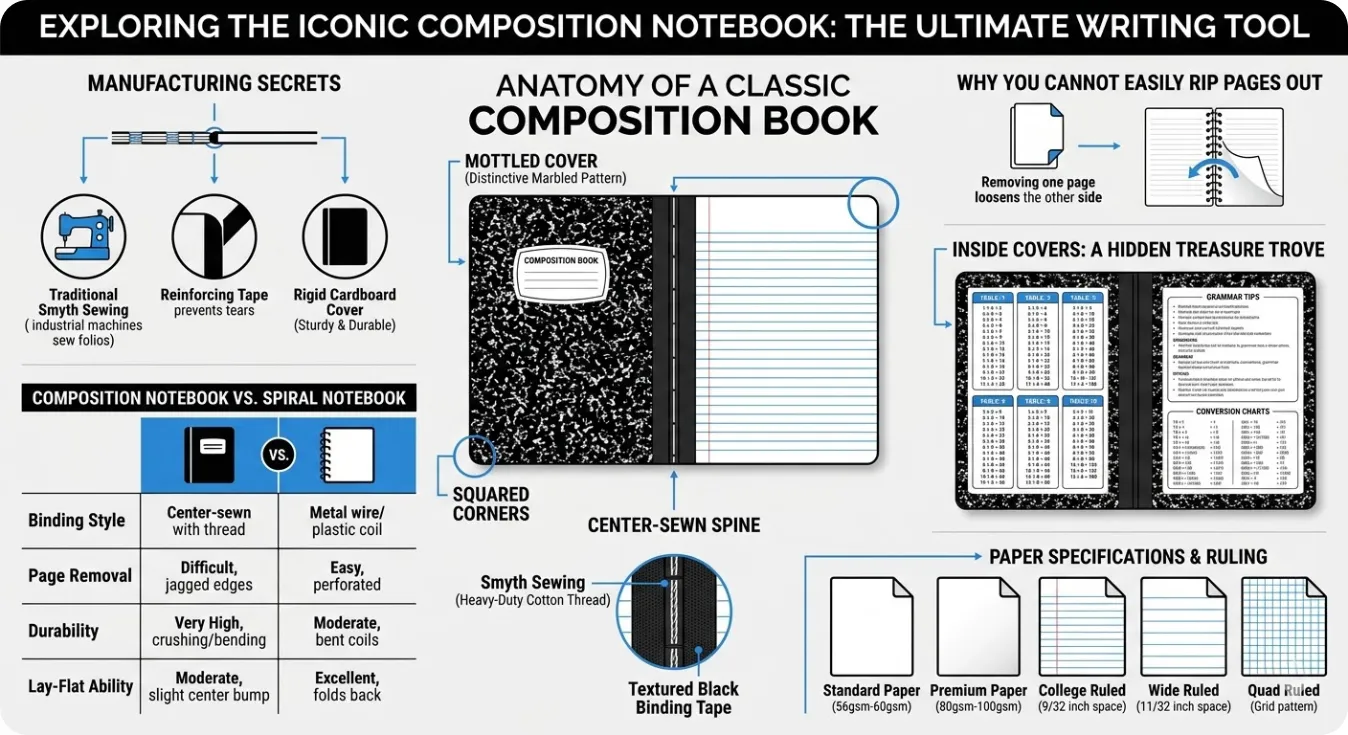
The Lay-Flat Design: Unlike spiral notebooks that tend to close or curl, composition notebooks open flat and stay open—a feature valued by writers and note-takers who need hands-free writing.
Durable Construction: The sewn binding is more durable than glue-only binding. Pages are less likely to fall out, and the book maintains its structural integrity through heavy use.
Classic Aesthetics: The marbled cover became iconic, but modern composition notebooks offer diverse designs—from minimalist solid colors to premium embossed patterns.
Affordable Quality: Traditional composition notebooks offer exceptional value: a durable, functional notebook at a price point accessible to students and professionals alike.
Composition Notebooks vs. Other Notebook Types
Comparing Notebook Formats
Composition Notebook vs. Spiral Notebook:
| Factor | Composition Notebook | Spiral Notebook |
|---|---|---|
| Binding | Sewn, lay-flat | Coil wire, may curl |
| Durability | High | Moderate (wire can bend) |
| Page security | Excellent | Good (perforated pages) |
| Professional appearance | Classic, formal | Casual |
| Price range | $3-20 | $5-30 |
| Customization | Limited (cover design) | Moderate (cover + page layout) |
Composition Notebook vs. Leather Journal:
| Factor | Composition Notebook | Leather Journal |
|---|---|---|
| Primary material | Paper/cardboard cover | Genuine or top-layer leather |
| Price position | Budget to mid-range | Mid-range to luxury |
| Target market | Students, general consumers | Professionals, gift buyers |
| Customization | Cover-focused | Extensive (cover, paper, binding) |
| Perceived value | Functional | Premium, artisanal |
| MOQ (B2B) | 200-1000 pieces | 50-500 pieces |
Composition Notebook vs. Bullet Journal:
| Factor | Composition Notebook | Bullet Journal |
|---|---|---|
| Origin | 19th-century education | Modern productivity system |
| Page format | Pre-printed ruled/graph | Dot grid for customization |
| Target user | Students, general | Productivity enthusiasts |
| Brand focus | Established brands | Maker/craft oriented |
| Typical cover | Cardboard, marbled | Various, often premium |
Market Applications
Educational Institutions
Despite digital transformation in education, composition notebooks remain required supplies in many schools. Teachers specify them for:
- Writing assignments and journals
- Science lab notes
- Mathematics problem-solving
- Foreign language practice
Educational purchasing is highly price-sensitive and volume-driven, typically negotiated through office supply distributors.
Professional and Corporate Markets
Corporate Gifting: Companies use branded composition notebooks as:
- Employee welcome kits
- Conference and event swag
- Client appreciation gifts
- Promotional merchandise
Professional Services: Law firms, consulting companies, and architectural firms often provide high-quality notebooks to employees. Premium composition notebooks with leather covers align with professional image requirements.
Retail and E-Commerce
Consumer Retail: Stationery stores, bookstores, and gift shops carry composition notebooks across price points—from budget student versions to premium leather journals.
Cross-Border E-Commerce: Amazon, AliExpress, and Etsy sellers source composition notebooks for:
- Private label resale under their brand
- Dropshipping businesses
- Niche market specialization (artists, writers, specific professions)
- Custom branded orders for corporate clients
Key E-Commerce Considerations:
- FBA (Fulfillment by Amazon) requirements
- Product photography and listing optimization
- Customer review management
- Seasonal demand patterns (Q3/Q4 peak for back-to-school)
Specialty and Luxury Markets
Premium composition notebooks—particularly those featuring leather covers, premium paper, and hand-finished details—serve:
- Luxury stationery enthusiasts
- High-end corporate gifting programs
- Wedding and event stationery
- Collectible and limited-edition releases
Sourcing Composition Notebooks: B2B Considerations
Finding Manufacturers
Primary Sourcing Channels:
- Alibaba/Made-in-China: Largest supplier base, verify credentials carefully
- Industry trade shows: Paperworld (Frankfurt), National Stationery Show (NYC)
- Direct manufacturer outreach: For established brands with clear requirements
- B2B directories: Global Sources, Kompass
Verification Framework:
| Criterion | Minimum | Preferred |
|---|---|---|
| Years in business | 3+ | 5+ |
| Export experience | 2+ years | Direct to your market |
| Production capacity | Meets your MOQ | 2x your projected volume |
| Quality certifications | Basic QC | ISO 9001 |
| Sample capability | Available | Free or low-cost samples |
Minimum Order Quantities
MOQ varies by manufacturer and customization level:
| Product Type | Typical MOQ | Notes |
|---|---|---|
| Standard composition notebook | 200-500 pieces | May mix designs |
| Custom cover design | 500-1000 pieces | Set-up fees may apply |
| Custom size/paper | 1000+ pieces | Longer lead times |
| Premium leather journal | 50-200 pieces | Higher unit price |
Pricing Structure
Factors Affecting Unit Price:
- Order quantity (economies of scale)
- Cover material (cardboard vs. leather vs. faux leather)
- Page count and paper quality
- Binding type and finishing
- Customization requirements
- Packaging specifications
Price Ranges (FOB China):
| Type | Unit Price Range |
|---|---|
| Standard cardboard cover | $0.80-2.50 |
| Faux leather cover | $2.00-6.00 |
| Genuine leather cover | $8.00-25.00 |
| Premium/mixed materials | $15.00-50.00+ |
Lead Time Considerations
| Order Type | Typical Lead Time |
|---|---|
| Stock designs, no customization | 2-4 weeks |
| Custom cover design | 4-6 weeks |
| Custom size/paper specifications | 6-10 weeks |
| Full custom development | 10-16 weeks |
| Shipping (sea freight) | 3-5 weeks |
| Shipping (air freight) | 5-10 days |
Premium and Luxury Alternatives
Leather Composition Notebooks
For brands targeting mid-to-high-end markets, leather composition notebooks offer superior margins and perceived value:
Features of Premium Leather Composition Notebooks:
- Top layer cow leather covers: Durable, develops patina over time
- Premium interior paper: 100-120gsm acid-free paper
- Hand-stitched binding: Traditional bookbinding techniques
- Professional finishing: Foil stamping, embossing, debossing
- Accessories: Ribbon markers, pen loops, elastic closures
Market Positioning:
| Segment | Price Range (Retail) | Target Customer |
|---|---|---|
| Mid-range | $25-50 | Professionals, gift buyers |
| Premium | $50-100 | Luxury stationery, corporate gifts |
| Luxury | $100-250+ | Collectors, high-end gifting |
Why B2B Buyers Choose Leather Alternatives
- Higher perceived value: Leather covers justify premium pricing
- Better margins: Unit costs vs. retail prices offer stronger margins
- Brand differentiation: Custom leather products build brand identity
- Durability narrative: Premium materials support sustainability messaging
- Corporate market access: Corporate buyers increasingly request premium, sustainable options
How Manufacturers Produce Quality Composition Notebooks
Production Process Overview
1. Material Preparation:
- Cover material cutting (die-cutting for efficiency)
- Interior page printing and ruling
- Endpaper preparation
2. Binding Assembly:
- Gathering and collating signatures (page groups)
- Sewing or stitching signatures together
- Attaching cover to text block
3. Finishing:
- Trimming to final size
- Spine rounding and backing (if applicable)
- Cover lamination or coating
- Surface decoration (foil, emboss, print)
4. Quality Control:
- Inspection of materials before production
- In-process quality checks
- Final inspection against specifications
- Packaging quality assessment
Key Quality Indicators
Binding Quality:
- Thread tension even throughout
- No loose pages when tested
- Cover attachment secure but flexible
Page Quality:
- Consistent ruling or grid alignment
- Paper weight uniformity
- No ink bleed or show-through
- Proper page adhesion to binding
Cover Durability:
- Material thickness appropriate for use case
- Corners properly formed and reinforced
- Closure mechanisms function correctly
FAQ
What is the difference between a composition notebook and a regular notebook?
A composition notebook specifically refers to notebooks with sewn binding and typically a marbled or simple cover. “Regular notebook” is a broad term encompassing spiral-bound, glued, ring-bound, and other formats. Composition notebooks are distinguished by their lay-flat capability and durability.
What are composition notebooks used for?
Composition notebooks serve diverse applications: student note-taking and assignments, professional journaling and note-keeping, bullet journaling and personal organization, gift and promotional products, and specialty stationery collections.
What size are composition notebooks?
Standard US composition notebooks measure 7.5″ x 9.5″ (192mm x 241mm). A5 size (5.8″ x 8.3″) is common internationally. Custom sizes are available for B2B orders with appropriate MOQs.
Can I customize composition notebooks with my brand logo?
Yes. B2B manufacturers offer various customization options:
- Cover printing: Full-color custom designs
- Embossing/debossing: Raised or recessed logo treatment
- Foil stamping: Metallic logo application
- Inside cover printing: Brand information, contact details
MOQ for custom logo orders typically starts at 500-1000 pieces depending on complexity.
What is the typical page count for composition notebooks?
Standard composition notebooks contain 80-200 pages (40-100 sheets). Educational versions often specify exact page counts. Premium versions may offer 160-300+ pages.
What paper weight is used in composition notebooks?
Standard interior paper ranges from 60-90gsm. Premium versions use 100-120gsm acid-free paper. Higher gsm provides better writing experience and reduced show-through.
Conclusion
Composition notebooks have earned their place as enduring stationery essentials. From their 19th-century origins in educational settings to their current role serving diverse markets—students, professionals, corporate buyers, and luxury stationery enthusiasts—these durable, functional notebooks have proven their lasting relevance.
For B2B buyers, composition notebooks represent both a stable market opportunity and a gateway to premium product expansion. The key to success lies in:
- Understanding your target market: Educational buyers prioritize price; corporate and luxury buyers prioritize quality and customization
- Selecting the right manufacturer: Due diligence on production capability, quality systems, and communication efficiency pays dividends
- Planning for scalability: Start with conservative MOQs, validate product quality, then scale with confidence
- Positioning for margins: Premium materials and custom branding unlock better unit economics
Whether you serve budget-conscious students, corporate gifting programs, or luxury stationery collectors, composition notebooks offer a versatile product category with proven market demand.
About 21Journal
21Journal is a professional leather notebook and journal manufacturer based in Shanghai, China. Established in 2007, we specialize in OEM/ODM manufacturing of premium leather notebooks including Leather Journals, Travel Journals, Leather Planners, and composition notebook alternatives in genuine leather.
Our Capabilities:
- 1000+ proprietary designs
- Full customization (logo, size, materials, binding)
- MOQ starting at 100 pieces per design
- CE/REACH/FSC compliant materials available
- Sample development in 7-14 days
Production Specifications:
- Cover materials: Top layer cow leather, genuine leather, faux leather
- Paper: 80-120gsm acid-free options
- Binding: Sewn, stitched, or hand-bound
- Monthly capacity: 50,000+ pieces
Contact our B2B team for customized quotations and sample requests.
21Journal — Premium Leather Notebooks and Journals Since 2007