How Big Are Composition Notebooks? Wondering about the exact dimensions of that classic marbled journal sitting on your desk? I will show you exactly how big composition notebooks are so you can choose the perfect fit for your next project. Let’s dive into the standard measurements and discover why they actually matter.
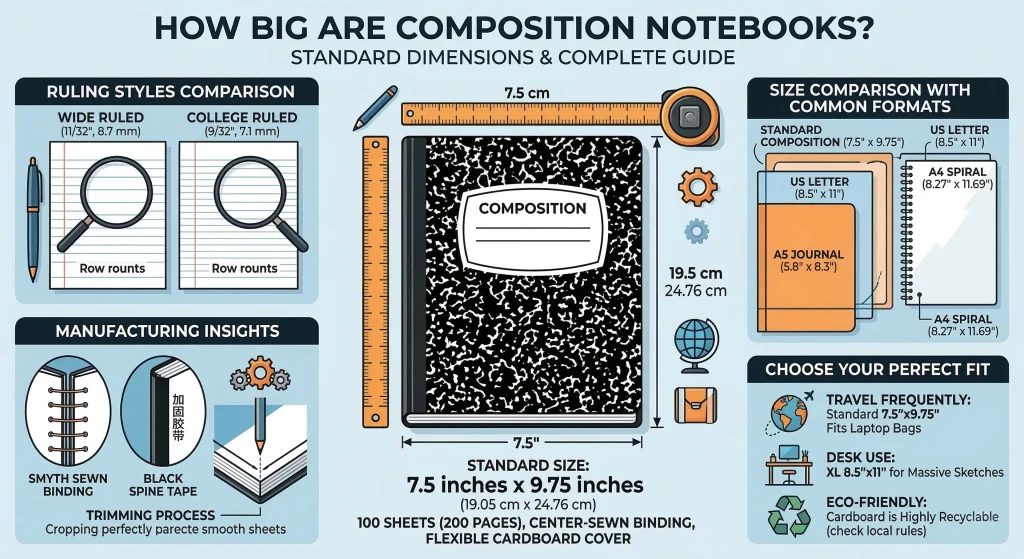
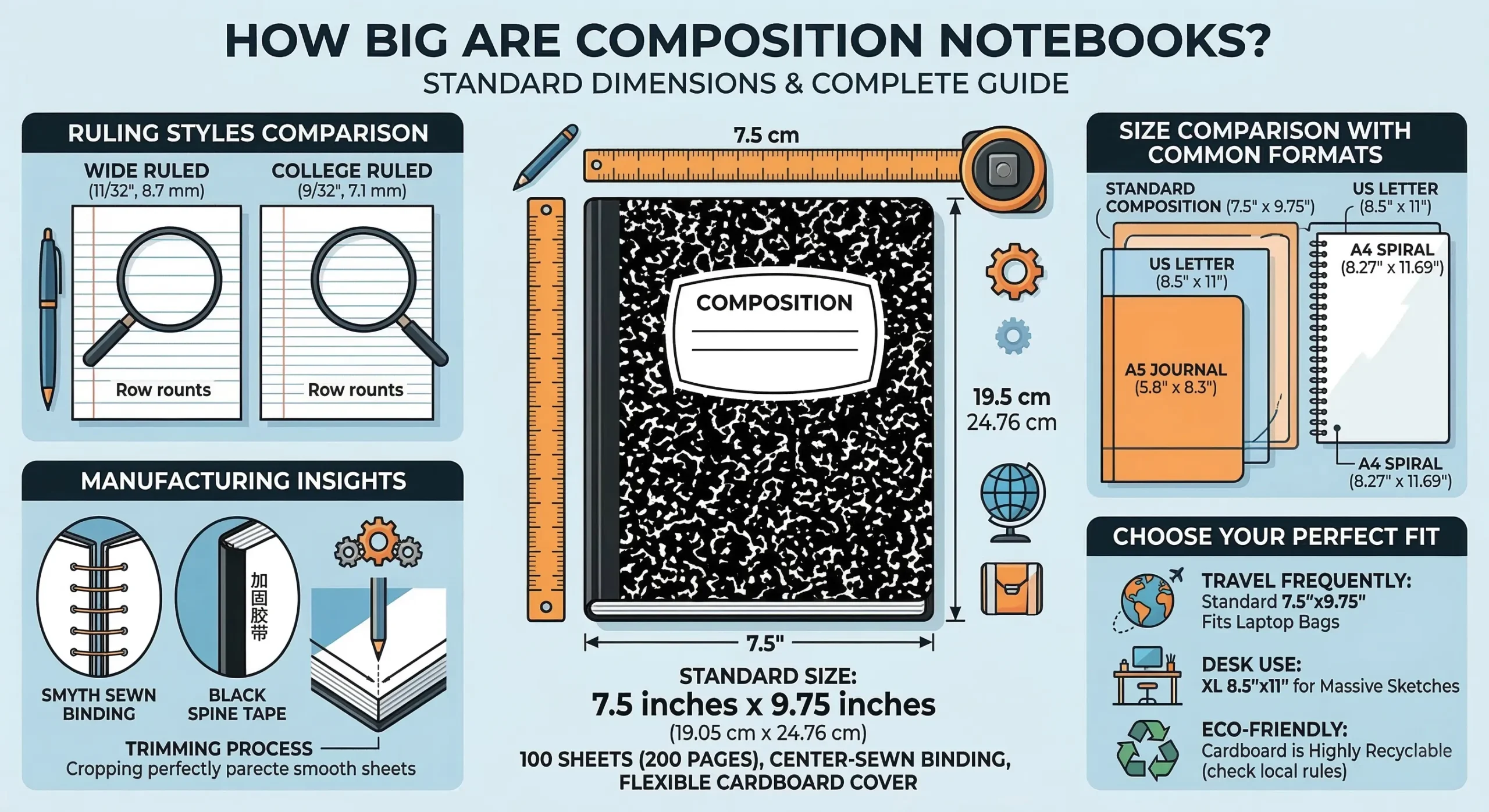
The standard size of a composition notebook is exactly 7.5 inches by 9.75 inches (19.05 cm x 24.76 cm). These classic notebooks typically contain 100 sheets (200 pages) of wide-ruled or college-ruled paper, featuring a durable center-sewn binding and a flexible cardboard cover.
However, standard dimensions only tell a fraction of the story. Stick around, because I am going to break down alternative sizes, international equivalents, and manufacturing secrets that dramatically affect your writing experience.
The Standard Composition Notebook Size Explained
If you walk into any office supply store, you will immediately recognize the iconic black-and-white marbled cover. But how big are composition notebooks in reality? The standard size sits firmly at 7.5 x 9.75 inches.
Consequently, this footprint makes them slightly smaller than a standard US Letter size paper, which measures 8.5 x 11 inches. You might wonder why manufacturers chose this specific dimension instead of a standard printer paper size. In fact, this unique trim size makes the notebook highly portable while still offering plenty of room for taking detailed notes.
Why Aren’t They Regular A4 or US Letter Size?
Historically, bookbinders created composition notebooks to be incredibly compact and rugged. If you make a notebook too large, the flexible cardboard covers tend to bend and degrade quickly when you shove them into a backpack. Therefore, keeping the dimensions strictly at 7.5 by 9.75 inches provides necessary structural integrity.
Furthermore, this specific size perfectly accommodates center-sewn binding. Unlike spiral coils that can snag on your clothes, the tightly stitched spine on a composition book keeps the pages securely locked in place.
According to the Book Manufacturers’ Institute standards, sewn bindings perform exceptionally well when paired with slightly trimmed page blocks. Naturally, this traditional sizing has remained the absolute industry standard for well over a century.
A Complete Breakdown of Composition Notebook Dimensions
While the classic 7.5″ x 9.75″ format rules the school supplies aisle, you can actually find a few distinct variations on the market today. Depending on the brand, you might encounter miniature or extra-large versions.
To make things incredibly simple, I put together a quick comparison table of the most common sizes available:
| Notebook Type | Dimensions (Inches) | Dimensions (Centimeters) | Best Used For |
| Standard Composition | 7.5″ x 9.75″ | 19.05 x 24.76 cm | School notes, daily journaling |
| Mini Composition | 4.5″ x 3.25″ | 11.43 x 8.25 cm | Pocket lists, quick memos |
| Extra Large (XL) | 8.5″ x 11″ | 21.59 x 27.94 cm | Lab reports, massive sketches |
| B5 Equivalent | 6.9″ x 9.8″ | 17.53 x 24.89 cm | Professional office use |
As you can see, understanding exactly how big composition notebooks are helps you buy the right tool for the job. You definitely do not want to buy a mini version when you actually need to write a massive college essay.
Manufacturing Insights: What Happens on the Factory Floor?
Let’s peek behind the curtain for a second. Working closely with notebook manufacturing operations and optimizing product lines, I know exactly how these dimensions impact the final product.
When a factory produces these journals, they do not just print on pre-cut 7.5 x 9.75-inch paper. Instead, manufacturers print the ruled lines onto massive parent sheets of paper. Afterward, heavy industrial guillotines trim the entire bound book down to its final marketable size.
This aggressive trimming process creates the perfectly smooth edges you see on a fresh notebook. Because of this specific manufacturing technique, you might sometimes find a notebook that is a tiny fraction of an inch smaller than the standard size.
The Critical Role of Paper Weight (GSM)
Size is not just about length and width; overall thickness matters immensely. Most standard, budget-friendly composition notebooks use 56gsm to 60gsm paper to keep the production costs down.
However, if you buy premium versions, you will often see 80gsm or even 100gsm wood-free paper. Consequently, a 100-sheet notebook made with superior 80gsm paper will feel significantly thicker and heavier than a standard cheap alternative.
Exploring Cover Materials and Binding Techniques
When you analyze how big composition notebooks are, you also have to look at the materials that make up that footprint. The classic design relies on a very specific, time-tested construction method.
Traditionally, manufacturers bind these journals using a technique called Smyth sewing. Instead of applying cheap glue or metal staples, sturdy thread sews the paper folios securely together. Consequently, this allows the notebook to lay relatively flat when you open it on a desk.
Why the Spine Tape Matters
Have you ever noticed the black tape running down the spine of a classic marbled notebook? That tape actually plays a vital structural role.
The manufacturer wraps this durable binding tape tightly around the sewn spine to reinforce the interior stitching. Therefore, the tape prevents the cover from ripping away from the paper block when you treat the notebook roughly.
Cardboard vs. Poly Covers
The cover material also subtly affects the overall thickness and weight of the book. Traditional versions use a rigid, mottled cardboard cover that absorbs scuffs easily.
Recently, however, many brands started producing poly (plastic) covers. While a poly cover provides excellent water resistance, it usually feels slightly thinner than the classic cardboard version, slightly reducing the overall bulk of the notebook.
Does Line Spacing Change the Overall Size?
You might be asking yourself if the ruling style changes how big composition notebooks are. The short answer is absolutely no. The exterior dimensions remain exactly the same regardless of what prints on the inside pages.
However, the ruling dictates exactly how much information you can fit onto a single page. If you want to maximize your writing space, you need to pay close attention to the line spacing before you buy.
Here is how the common ruling styles break down:
- Wide Ruled: Features 11/32 inches (8.7 mm) of space between the lines. This spacing works best for younger students or people with very large handwriting.
- College Ruled: Offers 9/32 inches (7.1 mm) of space between the lines. This narrower gap allows you to fit way more text on a standard 7.5″ x 9.75″ page.
- Quad Ruled (Graph): Usually features a strict 4×4 or 5×5 grid per inch. Engineers and math students love this format for drawing precise diagrams and charts.
How Composition Notebooks Compare to Other Popular Sizes
To truly understand how big composition notebooks are, we need to compare them directly to other standard formats you might currently use.
If you normally write in a standard A5 journal (which measures 5.8 x 8.3 inches), a composition book will feel significantly wider and taller. In fact, it provides almost 30% more writing surface area per page.
Conversely, if you compare it to a standard A4 spiral notebook (8.27 x 11.69 inches), the composition size feels delightfully compact. You can easily hold it in one hand while standing up, which makes it a favorite among journalists, warehouse managers, and active students alike.
Are Composition Notebooks Eco-Friendly?
Since we are actively discussing materials and manufacturing, we should quickly touch on sustainability. Many people wonder if they can easily recycle these specific notebooks once they fill them up.
Because the traditional design uses only paper, cardboard, and cotton thread, they are highly recyclable. You do not have to worry about removing a stubborn metal spiral coil before tossing it into the blue bin.
However, if you purchase a modern version featuring a poly plastic cover, you must rip that plastic off before recycling the paper core. Always check your local municipal recycling guidelines to be absolutely sure.
How to Choose the Perfect Composition Notebook
Now that you know exactly how big composition notebooks are, how do you pick the right one? I always tell people to match the notebook size directly to their specific daily workflow.
If you travel frequently or commute to an office, you might want to stick with the standard 7.5 x 9.75-inch size. It slides perfectly into most modern laptop bags and messenger bags without bending the corners.
On the other hand, if you leave your journal on a desk all day, an Extra Large 8.5 x 11-inch version might give you the vast breathing room you crave for brainstorming.
The Final Verdict on Composition Notebook Sizes
So, how big are composition notebooks? In the vast majority of cases, you can expect a standard size of exactly 7.5 inches by 9.75 inches.
These classic dimensions offer the perfect balance between everyday portability and ample writing space. While you can certainly find mini and oversized variations on the market, the traditional size remains the undisputed king of the classroom and the office.
Furthermore, understanding the manufacturing process and the importance of paper GSM helps you appreciate exactly why these sturdy little books have survived for over a century. Now that you are a sizing expert, you can confidently stock up on the perfect notebooks for your next big writing project!