How To Buy Leather Notebooks? Want to upgrade your daily writing routine but feel totally lost looking at different cover materials? I will show you exactly how to buy leather notebooks that actually last a lifetime. Let’s find a journal that feels incredible and perfectly handles your favorite pens.
To buy a leather notebook, you first need to decide between full-grain genuine leather and synthetic PU leather based on your budget. Second, you must verify the internal paper weight, specifically looking for 80gsm or 100gsm wood-free paper to prevent ink bleed-through. Finally, you should examine the binding method to ensure the pages lay completely flat on your desk.
But honestly, a shiny exterior cover easily hides terrible manufacturing flaws. Keep reading, because I am going to expose the exact factory specifications you need to check before spending your hard-earned money.
How to Identify Genuine vs. Synthetic Leather
When you start shopping, the sheer volume of material terms will probably confuse you. Manufacturers use clever marketing language to make cheap plastics sound like premium hides. Therefore, you need to understand exactly what you are holding.
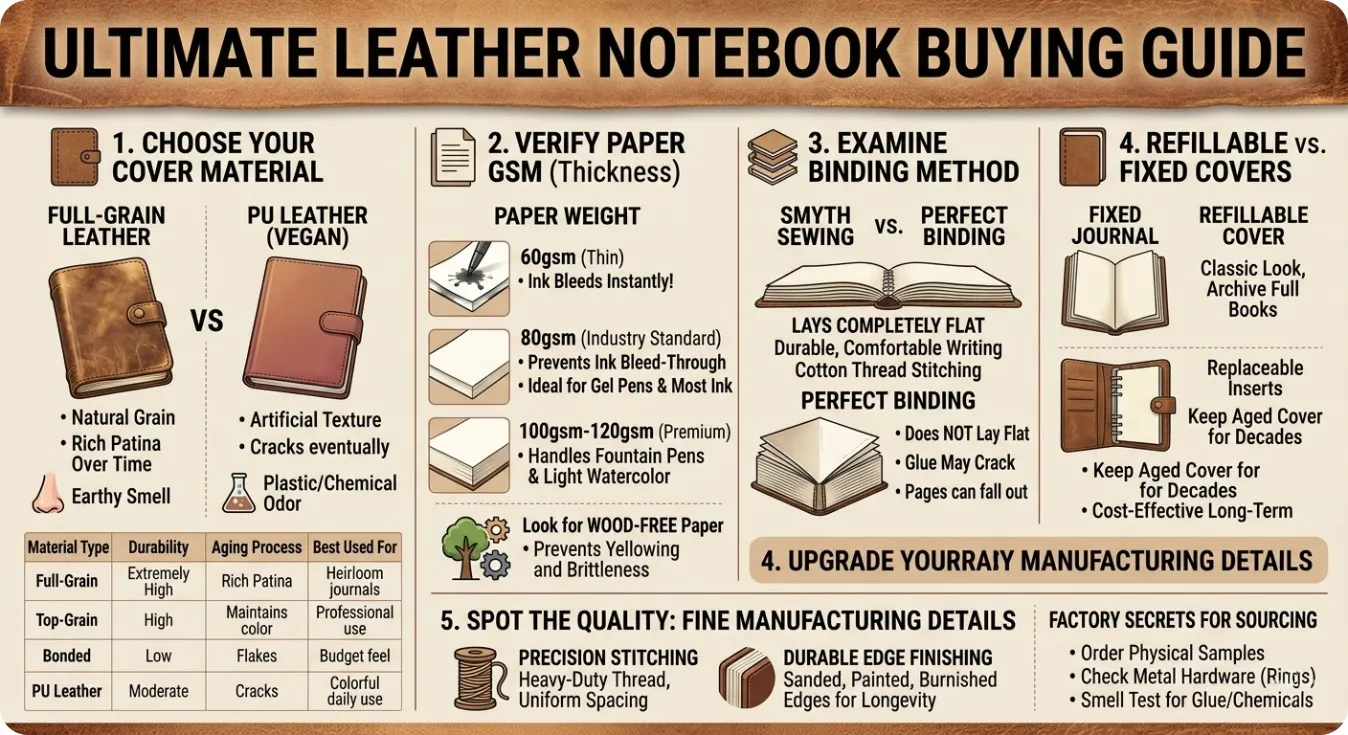
First, let us look at traditional genuine leather. Full-grain leather represents the absolute highest quality available on the market. Specifically, it features the outermost layer of the animal hide, which retains all the natural grain and rugged durability. If you want a notebook that develops a beautiful, dark patina over time, you must buy full-grain leather.
Conversely, you will frequently see the term “PU leather” or “vegan leather” in online listings. PU leather consists of a polyurethane plastic coating applied over a fabric backing. Naturally, it costs significantly less to produce than real animal hide.
Working heavily with notebook manufacturing operations, I see factories pump out thousands of PU leather covers daily. Because they stamp an artificial grain texture into the plastic, these covers look fantastic from a distance. However, they will eventually peel and crack after a few years of heavy use.
To make this incredibly simple, I put together a quick comparison table breaking down the core differences:
| Material Type | Durability | Aging Process | Best Used For |
| Full-Grain Leather | Extremely High | Develops a rich patina | Heirloom journals, luxury gifts |
| Top-Grain Leather | High | Maintains original color | Professional office notebooks |
| Bonded Leather | Low | Flakes over time | Budget-friendly real leather feel |
| PU Leather (Vegan) | Moderate | Cracks eventually | Colorful, water-resistant daily use |
According to the Leather Dictionary’s guide on material identification, smelling the material provides the easiest test. Real leather smells earthy and rich, whereas PU leather usually emits a faint chemical or plastic odor.
Why Paper GSM Determines the Writing Experience
You can buy the most beautiful cover in the world, but terrible paper will ruin your entire writing experience. Consequently, you have to look past the leather and investigate the paper specifications.
In the notebook manufacturing world, factories measure paper thickness using “GSM,” which stands for Grams per Square Meter. Basically, a higher GSM number means you get a thicker, heavier sheet of paper.
If a manufacturer wants to cut corners, they will fill a beautiful leather cover with cheap 60gsm paper. Unfortunately, if you try to use a fountain pen or a heavy gel rollerball on 60gsm paper, the ink will instantly bleed straight through to the other side.
To avoid this frustrating problem, you should memorize these standard paper weights:
- 60gsm to 70gsm: Very thin paper. It works adequately for standard ballpoint pens and dry graphite pencils, but liquid ink will bleed instantly.
- 80gsm Wood-Free Paper: The industry standard for high-quality journals. It feels crisp, handles most gel pens beautifully, and keeps the overall notebook relatively lightweight.
- 100gsm to 120gsm: Premium thickness. This heavy paper easily absorbs fountain pen ink and light watercolor washes without any ghosting.
- 160gsm+: Super heavy cardstock. Artists primarily use this extreme thickness for dedicated multimedia sketchbooks.
Furthermore, I highly recommend looking for “wood-free” paper. During the manufacturing process, chemical pulping removes the lignin from the wood fibers. As a result, wood-free paper will not turn yellow and brittle as it sits on your bookshelf over the years.
Understanding Durable Binding Techniques
Now that you understand the cover and the paper, we need to talk about how the factory holds it all together. The binding technique completely dictates how the notebook functions on your desk.
First, let us examine traditional case binding. High-end manufacturers usually employ a technique called Smyth sewing. Instead of gluing the pages directly to the leather spine, machines sew the paper signatures together using heavy cotton thread.
Because of this superior stitching method, a Smyth-sewn leather notebook will naturally lay completely flat when you open it. This makes writing across the center margin incredibly comfortable.
Conversely, cheaper brands often use perfect binding. In this process, the factory simply glues a stack of loose paper directly into the leather cover. While this saves money, the stiff glue prevents the book from laying flat. Eventually, the brittle glue cracks and your pages start falling out.
Refillable vs. Fixed Leather Covers
When you buy leather notebooks, you also face a major structural decision. Do you want a fixed journal or a refillable cover?
A fixed journal features paper permanently attached to the leather. Once you fill up all the pages, you archive the entire book on your shelf and buy a brand-new one. Many people love this style because it provides a seamless, classic look.
On the other hand, a refillable notebook features a separate leather jacket that wraps around a replaceable paper insert. Often, these use a metal ring binder mechanism or an elastic band system (like a classic traveler’s notebook).
If you invest in expensive full-grain leather, I always suggest buying a refillable model. Ultimately, this allows you to keep using the beautiful, aged leather cover for decades while simply swapping out cheap paper inserts every few months.
Manufacturing Details: Stitching and Edge Finishing
Let’s look closely at the tiny details that separate good journals from truly great ones. If you want to spot a high-quality product, you need to examine the perimeter stitching.
Premium leather workshops use heavy-duty, marine-grade thread to sew the edges of the cover. Furthermore, they keep their stitch lines perfectly straight and uniform. If you see frayed threads, skipped stitches, or wildly uneven spacing, you should probably put the notebook back on the shelf.
Additionally, pay close attention to the edges of the leather. Raw leather edges look fuzzy and absorb moisture quickly. To prevent this, skilled craftsmen apply a specialized edge paint. They sand the leather smooth, paint the edge, and burnish it until it feels like glass. This vital step prevents the edges from fraying when you constantly shove the notebook into your briefcase.
According to the TAPPI standards for paper and binding manufacturing, superior edge finishing significantly extends the lifespan of any bound product.
Factory Secrets for Sourcing Journals
If you ever decide to buy leather notebooks in bulk for corporate gifts, you need to think like a wholesale buyer. Sourcing directly from overseas manufacturers requires a sharp eye for hidden flaws.
First, never trust a simple product photo. Factories can easily digitally alter images to make cheap PU leather look identical to full-grain cowhide. Therefore, you must always order a physical sample before committing to a large run.
Second, check the hardware. If you buy a refillable binder, test the metal rings. Cheap binder rings often arrive misaligned, which causes your paper pages to snag and tear every time you turn them. You want to ensure the factory uses heavy-duty, rust-resistant stainless steel for all the internal mechanisms.
Finally, smell the sample the moment you open the box. If you smell harsh industrial glue or strong chemical solvents, the factory likely rushed the production process. High-quality manufacturing operations allow their adhesives to cure and off-gas properly before shipping the final product.
The Final Verdict on Choosing Your Journal
So, how do you successfully buy leather notebooks that meet your exact needs? You simply need to stop looking at the brand name and start looking at the structural specifications.
First, determine if your budget allows for genuine full-grain leather, or if a colorful, synthetic PU leather cover better suits your daily lifestyle. Next, turn your attention to the interior. Always demand 80gsm or 100gsm wood-free paper so your fountain pens glide smoothly without bleeding through the page.
Finally, check the structural integrity. Look for flexible Smyth-sewn bindings that lay flat, or choose a sturdy refillable cover that you can use forever. By closely inspecting these manufacturing details, you avoid cheap knockoffs and guarantee you buy a beautiful leather notebook that will handle your brilliant ideas for years to come.