How to choose a notebook manufacturer? Looking to source custom notebooks but feeling totally overwhelmed by the endless factory options? I’ve navigated the complex world of B2B manufacturing to bring you the exact blueprint for vetting suppliers.
To choose a notebook manufacturer, evaluate their production capacity, minimum order quantities (MOQs), and material certifications like FSC-certified paper. Request physical samples to test paper GSM, binding strength, and trim tolerance before negotiating terms. Always verify their export history and request third-party factory audits to ensure reliable, long-term supply chain operations.
Finding a supplier on a B2B directory is the easy part. Let’s dive into the exact technical questions you need to ask to separate top-tier factories from unreliable middlemen.
The Factory Vetting Process
When you operate in the ToB (business-to-business) space, your manufacturer can literally make or break your brand’s reputation. You need a partner who understands precise product specifications, not just someone who slaps a logo on a generic notepad.
The biggest mistake I see buyers make is falling for a trading company disguised as a direct manufacturer. Trading companies act as middlemen, which instantly inflates your unit cost and heavily dilutes your control over quality assurance.
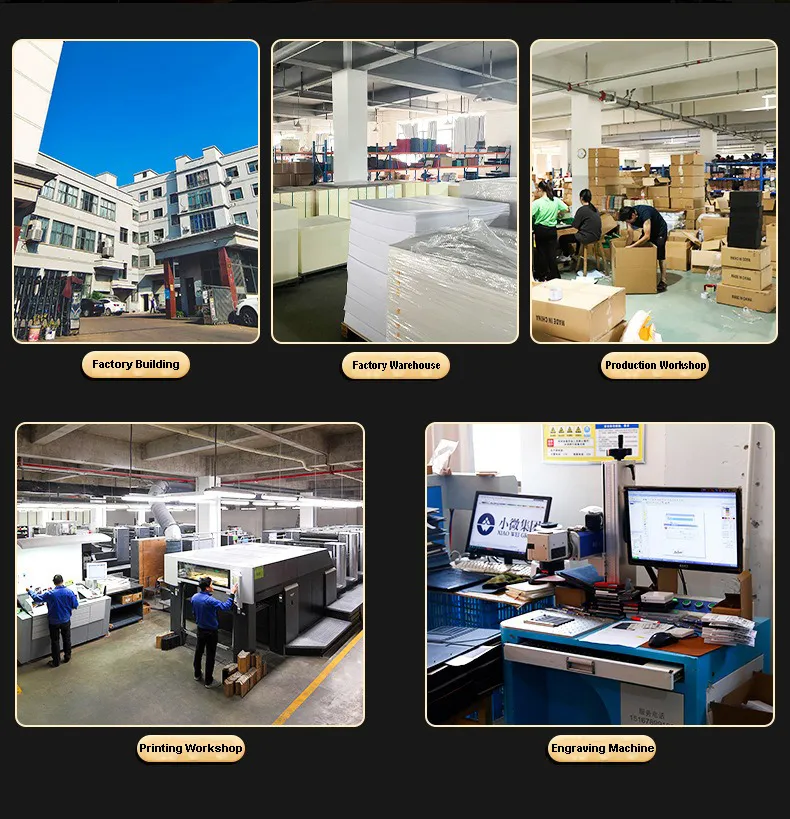
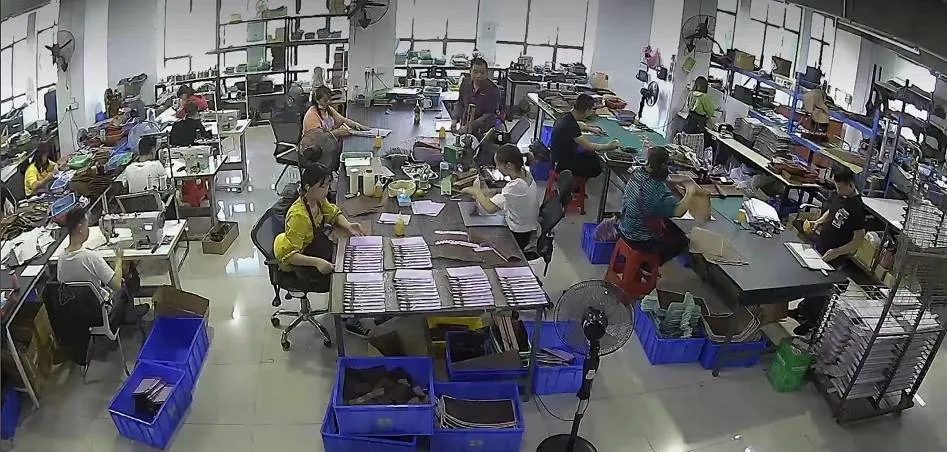
To filter them out, I always ask for a live video tour of the production floor. I want to see the giant Heidelberg printing presses and the industrial guillotine cutters in action. If they hesitate or make excuses, I walk away. You should also demand their ISO 9001 certification and a recent third-party factory audit report.
Technical Specs You Must Demand
A great notebook manufacturer won’t just say “yes” to everything. They will push back, ask for clarification on your specs, and offer engineering insights. When you are putting together your product catalog, you need to be incredibly granular about your material requirements.
Paper Sourcing and Ink Compatibility
Paper quality is the heartbeat of your notebook. If a factory simply offers “standard paper,” you need to dig much deeper. You should dictate the exact GSM (Grams per Square Meter) and specify whether you need uncoated woodfree paper or acid-free archival stocks.
If you are targeting a premium market, ask the factory about their calendering process. This determines how smooth the paper feels. You also need to verify if their paper is sized specifically for fountain pens to prevent the ink from bleeding and feathering.
Binding and Metal Components
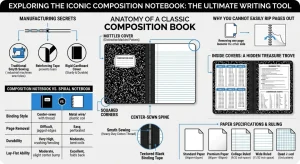
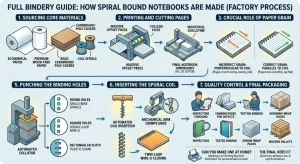
This is where a lot of cheap notebooks fail. If you are sourcing spiral or wire-o bound notebooks, you need to inspect the metal components rigorously.
Ask the factory exactly what metal grades they use for their wire spirals. I always check if they are using basic low-carbon galvanized steel or if they offer higher-grade, tinned steel for a premium finish. If your factory cannot explain the structural differences in their metal fasteners and double-loop bindings, they are likely outsourcing their hardware to the cheapest bidder.
Evaluating Production Capacity and MOQs
Every factory operates on different scales. You need to align your purchasing power with their business model. Here is a quick breakdown of how different manufacturer tiers usually operate.
| Manufacturer Tier | Typical MOQ | Customization Level | Best Fit For |
| Boutique / Print-on-Demand | 50 – 200 units | Low (Cover only) | Testing new market niches |
| Mid-Size Factory | 1,000 – 3,000 units | High (Custom paper, wire, size) | Growing e-commerce brands |
| Large-Scale Industrial | 10,000+ units | Fully Custom (Custom molds/dies) | Enterprise ToB volume |
If a massive industrial factory accepts a tiny 100-unit order, that is actually a red flag. It often means they are subcontracting your small order to a lesser-known, unregulated workshop to keep their main assembly lines free. Stick to a partner whose MOQ aligns perfectly with your current scaling phase.
The Sample Testing Phase
Never, under any circumstances, place a bulk manufacturing order without testing a physical prototype first. A digital mockup might look gorgeous on your monitor, but it tells you nothing about the tactile experience.
When your sample arrives, you need to put it through a rigorous stress test. Here is exactly what I look for:
- Trim Tolerance: Check the edges of the pages. Are they perfectly flush, or did the factory’s guillotine cutter leave jagged, uneven lines?
- Binding Rigidity: Grab the metal spiral and try to bend it. High-quality steel wire should snap right back into place without permanently deforming.
- Ink Ghosting: Test the paper with heavy, wet ink. If you can clearly read the writing from the back of the page, the factory used cheap, thin paper.
- Cover Durability: Toss the notebook into a heavy bag for a few days. The corners should resist crushing, and the cover lamination should not peel away.
If the sample fails any of these tests, you must force the factory to correct the issue before you wire a deposit.
Communication and Tech Integration
You can find a factory with the best printing presses in the world, but if their communication is terrible, your supply chain will eventually collapse.
I look for manufacturers who have dedicated, English-speaking account managers who respond within 24 hours. They need to understand complex technical jargon and be proactive about potential production delays. If you have to chase them down just to get a shipping update, they are not worth your time.
Furthermore, consider how their systems integrate with yours. As an e-commerce operator, you likely manage complex independent sites built on WordPress and Elementor. While a factory won’t directly touch your SEO or website backend, they do need to provide highly organized digital assets. They should seamlessly deliver high-resolution product photography, exact dimensional specs, and precise weight calculations so you can optimize your product listings without delay.
Summary
So, how do you choose a notebook manufacturer? Start by verifying that they are a true factory with solid ISO certifications and a strong export history, not just a trading middleman. Demand precise technical specifications for both the paper weight and the metal binding components to ensure premium quality. Finally, thoroughly stress-test a physical sample and lock in a supplier whose MOQs and communication style perfectly align with your B2B growth strategy.