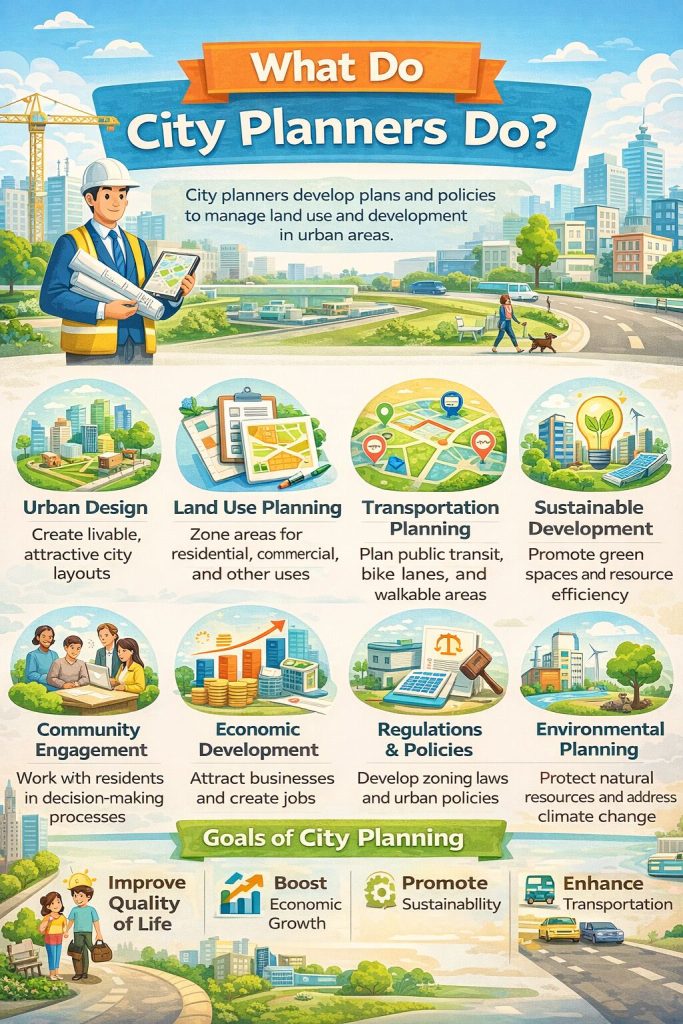
City planners, also known as urban planners, play a critical role in shaping how cities and communities grow, function, and evolve. Their work influences everything from housing and transportation to economic development and environmental sustainability. While their impact is often visible in skylines, neighborhoods, and infrastructure systems, the day-to-day responsibilities of city planners are less widely understood. This guide provides a detailed explanation of what they do, where they work, and why their role is essential in modern society.
1. The Role
At their core, city planners are responsible for guiding the development and use of land within cities, towns, and regions. They work to balance competing needs such as economic growth, environmental protection, public health, and quality of life.
They analyze current conditions, forecast future needs, and develop plans and policies that shape how communities develop over time. Their goal is to create functional, equitable, and sustainable places for people to live, work, and interact.
2. Key Responsibilities
City planners perform a wide range of tasks that combine technical analysis, policy development, and public engagement.
Land Use Planning
City planners determine how land should be used – residential, commercial, industrial, or recreational. They develop zoning codes and land-use maps that regulate development and ensure compatible uses within neighborhoods.
Long-Term Planning
Planners create comprehensive or master plans that outline a city’s vision for growth over 10, 20, or even 50 years. These plans address housing, transportation, infrastructure, public services, and environmental considerations.
Development Review
City planners review development proposals to ensure they comply with zoning regulations, building codes, and planning policies. This may include evaluating site plans, environmental impact studies, and design standards.
Policy and Regulation Development
Planners help draft and update policies related to housing affordability, transportation, sustainability, historic preservation, and economic development.
3. Transportation and Infrastructure Planning
Transportation is a major focus of city planning. Planners work with engineers and transit agencies to design systems that move people and goods efficiently.
This includes:
- Road networks and traffic flow
- Public transit systems
- Bicycle and pedestrian infrastructure
- Parking policies
Infrastructure planning also covers utilities such as water, sewer, energy, and telecommunications, ensuring cities can support future growth.
4. Environmental and Sustainability Planning
Modern city planners play a key role in environmental protection and climate resilience. They incorporate sustainability principles into land-use decisions and development standards.
Common areas of focus include:
- Green space preservation
- Floodplain management
- Climate adaptation strategies
- Renewable energy planning
- Reducing urban sprawl
Planners help cities grow responsibly while minimizing environmental impact.
5. Housing and Community Development
Housing is one of the most pressing issues facing cities today. City planners work to ensure that communities provide adequate, affordable, and diverse housing options.
Their responsibilities may include:
- Analyzing housing supply and demand
- Supporting affordable housing initiatives
- Reviewing residential developments
- Addressing homelessness and displacement
Planners aim to create inclusive communities that serve residents across income levels and life stages.
6. Economic Development and Revitalization
City planners support local economies by encouraging development that creates jobs, attracts investment, and revitalizes underused areas.
This can involve:
- Downtown redevelopment plans
- Mixed-use zoning strategies
- Incentives for business growth
- Brownfield redevelopment
By aligning land use with economic goals, planners help cities remain competitive and resilient.
7. Public Engagement and Communication
A significant part of a city planner’s job involves working with the public. Planners organize community meetings, workshops, and hearings to gather input from residents, businesses, and stakeholders.
Effective public engagement helps ensure that planning decisions reflect community needs and values. Planners also communicate complex technical information in ways that are accessible to non-experts.
8. Where City Planners Work
City planners are employed in a variety of settings, including:
- Local and regional governments
- State and federal agencies
- Planning and design consulting firms
- Nonprofit organizations
- Real estate development companies
Their roles may vary depending on the organization, but the core principles of planning remain consistent.
9. Education and Skills Required
Most city planners hold a degree in urban planning, urban studies, geography, public policy, or a related field. Many positions require a master’s degree in urban or regional planning.
Key skills include:
- Analytical and research skills
- Knowledge of planning laws and regulations
- Communication and negotiation abilities
- Data analysis and GIS proficiency
- Problem-solving and critical thinking
Professional certification, such as AICP (American Institute of Certified Planners), is often valued.
10. Challenges Face
City planners operate in complex environments with competing interests and limited resources. Common challenges include:
- Balancing growth with sustainability
- Managing political pressures
- Addressing housing affordability
- Responding to climate change
- Coordinating across agencies
Despite these challenges, planners play a vital role in navigating trade-offs and finding long-term solutions.
11. Why City Planners Matter
The decisions city planners make have long-lasting impacts. Well-planned cities are more livable, equitable, and resilient. Poor planning, by contrast, can lead to congestion, environmental degradation, and social inequality.
City planners help shape places where people can thrive – connecting policy, design, and community needs into a cohesive vision for the future.
12. Conclusion
So, what do city planners do? They guide how cities grow and function by managing land use, transportation, housing, infrastructure, and environmental systems. Through research, policy-making, and public engagement, they work to create communities that are sustainable, inclusive, and economically strong.
As cities continue to face rapid change, the role of city planners will only become more important. Their work ensures that urban development serves not just today’s needs, but the long-term well-being of future generations.