Ever bought a notebook online only to realize it is way smaller than you expected when it arrives? I have been there, and it is incredibly frustrating. I broke down the exact dimensions and manufacturing standards so you always know exactly what you are getting. What size is a standard notebook?
The most common standard notebook size is A4 (8.27 × 11.69 inches) internationally, while the US relies on Letter size (8.5 × 11 inches) for school and office work. However, for everyday journaling and personal use, the A5 size (5.83 × 8.27 inches) is the global standard.
But standard sizing is actually a lot more complex than just choosing between A4 or Letter. Let’s dive into the exact dimensions, regional differences, and the fascinating manufacturing process behind how to cut these pages on the factory floor.
The Two Heavyweights: ISO vs. US Sizing
When you start looking into notebook sizes, you quickly realize the world is split into two distinct camps. You have the international ISO system, and you have the North American standard system. Depending on where you live or where you source your products, these dimensions change dramatically.
If you are managing operations or writing product descriptions for an independent e-commerce site, getting this right is crucial. Shoppers get easily confused by regional naming conventions. Listing the exact millimeter dimensions alongside the standard name prevents a ton of customer service headaches down the road.
Let me explain exactly how these two dominant sizing systems work and why they are so different.
The Global Standard: ISO A-Series Explained
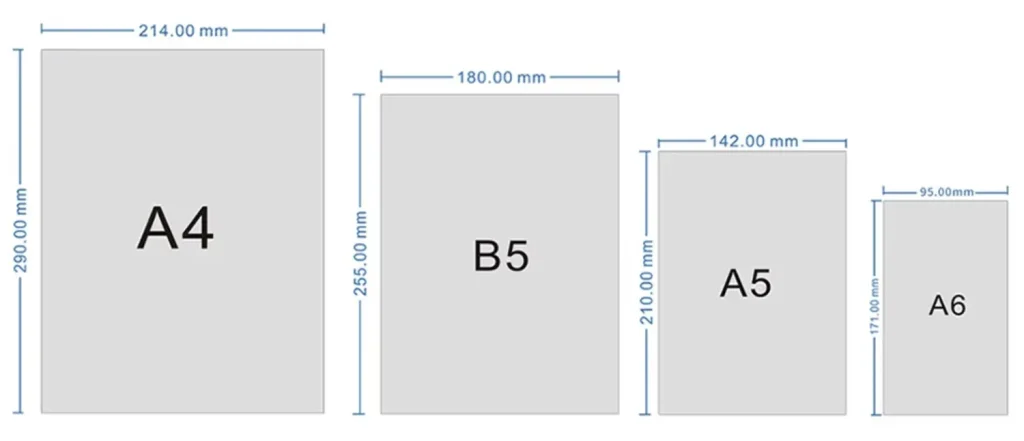
Outside of North America, almost every notebook manufacturer follows the ISO 216 standard. This system relies on the A-series of paper sizes, which includes the famous A4 and A5 formats. The beauty of the A-series lies in its brilliant mathematical design.
Every paper size in the A-series has an aspect ratio of 1 to the square root of 2 (1:1.414). Sometimes call this the Lichtenberg ratio. Because of this specific ratio, if you cut an A4 sheet of paper exactly in half, two perfectly proportioned A5 sheets.
This design creates a highly efficient, zero-waste manufacturing process. Paper mills can produce massive parent sheets of paper (A0 size) and simply cut them down in half again and again to create smaller notebooks. This keeps production costs incredibly low.
For everyday consumer notebooks, A5 (148 × 210 mm) is the undisputed king. It is compact enough to slide comfortably into a messenger bag, but large enough to give you plenty of room for taking detailed meeting notes.
The North American Rebels: US Paper Sizes
If you grew up in the United States or Canada, the A-series probably looks a little foreign to you. North America uses a completely different set of traditional sizes, largely based on historical printing press dimensions rather than strict mathematical ratios.
The absolute standard for US school and professional notebooks is the Letter size, measuring 8.5 by 11 inches. If you buy a standard spiral-bound college-ruled notebook at a big-box store, you are almost certainly buying a Letter-sized product.
You will also frequently see the Legal size (8.5 by 14 inches), though this is mostly reserved for specialized legal pads. For smaller, portable writing, North Americans often rely on the Junior Legal size (5 by 8 inches) or standard Memo pads, which loosely mimic the international A5 or A6 dimensions.
The Hidden Gem: B-Series Notebooks
While A4 and A5 get all the attention, there is another ISO standard that is secretly dominating the stationery market. The B-series, specifically the B5 size, is a massive hit, especially in Asian manufacturing hubs.
B5 measures 6.93 by 9.84 inches (176 × 250 mm). This makes it perfectly positioned right between the massive A4 and the compact A5. It is incredibly popular for student notebooks and bullet journals because it offers a generous writing canvas without feeling like you are hauling around a bulky textbook.
If you are dealing with B2B sourcing from overseas suppliers, you will see B5 notebooks offered everywhere. Just be aware that the Japanese Industrial Standard (JIS) for B5 is slightly different from the ISO B5 standard, so always double-check the millimeter specs with your factory.
Comparing Common Notebook Dimensions
To make things easy, I put together a quick cheat sheet. Here is a breakdown of how the most common notebook sizes stack up against each other across the globe.
| Notebook Size | Dimensions (Inches) | Dimensions (Millimeters) | Best Used For |
| US Letter | 8.5 x 11.0 | 216 x 279 | US school and office notes |
| A4 | 8.27 x 11.69 | 210 x 297 | International professional documents |
| B5 (ISO) | 6.93 x 9.84 | 176 x 250 | Student notes, daily bullet journals |
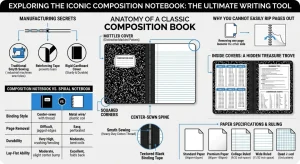
| Composition | 7.5 x 9.75 | 190 x 247 | US primary and secondary education |
| A5 | 5.83 x 8.27 | 148 x 210 | Personal diaries, compact planners |
| Pocket (A6) | 4.13 x 5.83 | 105 x 148 | Quick field notes, travel logs |
What About Proprietary Sizes?
Not every brand plays by the rules. Some of the most famous notebook companies in the world intentionally avoid standard ISO or US sizing. They do this to create a unique brand aesthetic and to force customers to buy their proprietary accessories.
Moleskine, for example, produces a “Large” notebook that measures 5 by 8.25 inches. This is noticeably narrower than a standard A5 notebook. While it looks sleek, it means standard A5 inserts or covers will not fit their products properly.
Another great example is the Traveler’s Notebook, which uses a tall, slender “Standard” size of roughly 4.3 by 8.2 inches. This odd dimension was designed specifically to hold standard travel tickets and maps. If you prefer these specialty brands, you just have to accept that standard sizing rules go out the window.
Manufacturing Insights: How Notebooks Are Cut
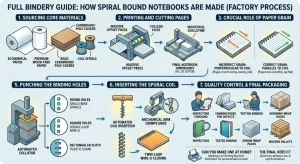
If you really want to understand notebook sizes, you have to look at how they are physically manufactured. A notebook does not just pop out of a machine perfectly sized. It is part of a rugged industrial process.
Commercial printers print the ruled lines or dot grids onto massive, continuous rolls of paper. Cut down these rolls into large sheets, folded into signatures (small booklets), and bound together. Finally, the entire assembled notebook push through an industrial guillotine cutter to clean up the edges.
The Bleed Margin and Trim Tolerance
Because paper shifts slightly during the printing and folding process, factories cannot print the lines exactly to the edge of the final size. Instead, they use something called a “bleed.” They print the grid slightly past where the final edge will be.
When the massive guillotine blade comes down to trim the notebook to its final size, it slices off that extra bleed. This ensures the ink goes perfectly off the edge of the page without leaving any ugly white borders.
However, this mechanical trimming process is not always perfect to the microscopic level. You have to account for trim tolerance.
What to Check When Managing Specs
If you are buying notebooks in bulk or verifying manufacturing specifications, you cannot just trust the label on the box. Here is exactly what you need to look out for:
- True Millimeter Dimensions: Always verify the actual millimeter count with your supplier. Do not just accept a vague “A5 size” label, as factory interpretations can vary.
- Trim Variance: Allow a 1 to 2 millimeter tolerance for factory guillotine cutting. A notebook labeled 210mm tall might actually be 208mm after a heavy trim.
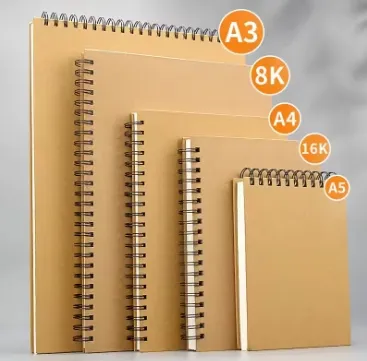
- Binding Consumption: Remember that spiral wire or perfect binding eats into the usable page width. The paper might be A5, but you lose a fraction of an inch to the spine.
- Cover Overhang: Hardcovers are usually manufactured slightly larger than the internal paper blocks. This overhang protects the page edges from getting crushed in your bag.
How to Choose the Right Size for Your Needs
With all these different dimensions flying around, picking the right notebook can feel a bit overwhelming. But it all boils down to how and where you plan to use it.
If you need a notebook that stays permanently on your office desk for sketching out big ideas or taking extensive meeting notes, an A4 or US Letter size could be a fantastic choice. The massive page size lets your ideas breathe.
If you are constantly on the move, commuting, or jumping between coffee shops, A5 is easily the smartest pick. It strikes the perfect balance between portability and usability. If A5 feels just a tiny bit too cramped for your handwriting style, B5 might be exactly the sweet spot you are looking for.
Summary
So, what size is a standard notebook? Internationally, the A4 (8.27 × 11.69 inches) dominates the office space, while the US heavily favors the Letter size (8.5 × 11 inches). However, for personal journals, planners, and everyday carry, the compact A5 size (5.83 × 8.27 inches) has comfortably become the global standard. By understanding these dimensions and regional differences, you can easily find the perfect canvas for your next big project.